52 countries
Map of Asia in 1600
LearnNo rush: we show you each piece and you go over what you miss.Learn capitalsEach capital in its place, five at a time.CountriesWe give you the name: tap it on the map!CapitalsWe give you the capital: tap its country!QuizArea, population, capitals and borders of the time: 4 options and one shot!ShapesJust the outline: can you tell which one it is?

Asia around 1600: the gunpowder empires
Asia around 1600: gunpowder and the sea routes had made great empires, the Ottoman, the Safavid, the Mughal and Ming China, while the Europeans founded their first outposts.
- The Ottomans held Anatolia, the Arab lands, Egypt and Iraq; the Safavids ruled Persia, with Isfahan as capital from 1598, and the two empires fought over Iraq, the Caucasus and Azerbaijan.
- Akbar's Mughal Empire ruled almost all of northern India, with some 100 million people, one of the richest states in the world; the Deccan sultanates and the south were still independent.
- Ming China was still the biggest state, but the Jurchen chief Nurhaci was uniting his people, who would found the Later Jin in 1616; in Japan Tokugawa Ieyasu won the battle of Sekigahara in 1600.
- The Europeans had arrived: Portugal held Goa, Malacca, Hormuz and Macau, Spain ruled the Philippines, and the English (1600) and Dutch (1602) East India Companies had just been founded. Peoples with no state are marked “no capital”; the outlines are a rough guide and the population figures are estimates used only to compare.
How it is made: the coasts are today's, and the borders follow today's divisions where they match those of the time and, where they do not, lines drawn by hand, good to about 10 km. Shapes: Natural Earth (public domain). Compare with today's Asia →
Facts: the map of Asia in 1600
- On the map
- 52 countries · 4 are so small they show as a dot (complete level)
- Largest country
- Peoples of Siberia and the Arctic (≈ 12,000,000 km²)
- Smallest country
- Ryukyu Kingdom (≈ 2,300 km²)
- Most populous country
- Ming dynasty (≈ 180,000,000 people)
- Least populous country
- Indian Ocean islands (Maldives, Andaman, Nicobar) (≈ 50,000 people)
- Northernmost capital
- No capital (Peoples of Siberia and the Arctic)
- Southernmost capital
- Kotagede (Mataram Sultanate)
- Most neighbours
- Mughal Empire (Akbar's): 10
- No land border with another country on the map
- Indian Ocean islands (Maldives, Andaman, Nicobar), Ryukyu Kingdom, Sri Lanka (Kotte, Kandy, Jaffna), and Taiwan's indigenous peoples
Fun facts: Map of Asia in 1600
- Tokugawa Ieyasu won Sekigahara in 1600 and was shogun from 1603; his family ruled Japan for 265 years.
- Isfahan became Persia's capital in 1598 under Shah Abbas I, who rebuilt it around the huge Naqsh-e Jahan square.
- Akbar's capital Fatehpur Sikri was abandoned only about 14 years after it was founded, reportedly for lack of water.
- The English East India Company was founded in 1600 and the Dutch one in 1602, the first big joint-stock company.
- Manila, founded by Spain in 1571, was the end of the galleon route that carried Asian silk and Mexican silver across the Pacific.
Test yourself
Which was the largest country of Asia in 1600?
Peoples of Siberia and the Arctic.
Which was the most populous country of Asia in 1600?
Ming dynasty.
Which was the smallest country of Asia in 1600?
Ryukyu Kingdom.
Which was the least populous country of Asia in 1600?
Ainu (Ezo).
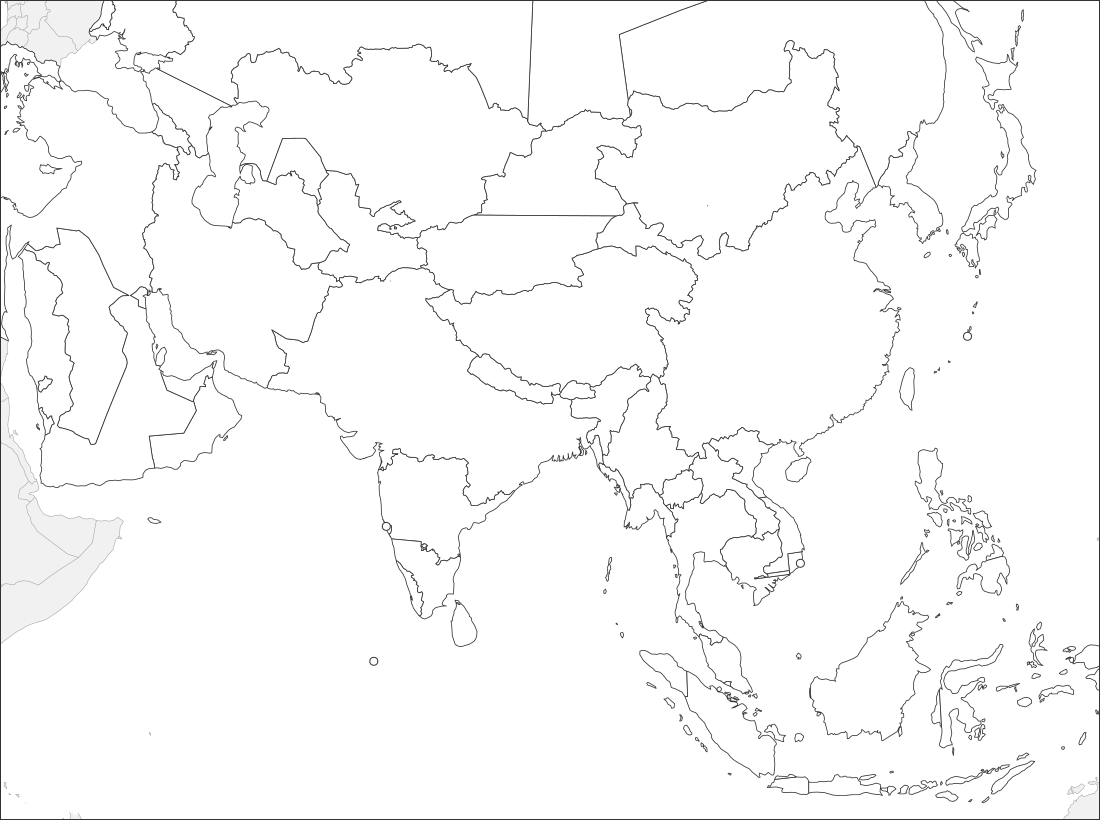
Printable blank map: Map of Asia in 1600
Print this blank map for free for class or self-study, then play the game to check your answers.
More maps
Asia in 100057 countriesAsia in 130055 countriesAsia in 191436 countriesAsia in 192443 countriesAsia in 194543 countriesAsia48 countriesEurope in 181552 countriesEurope in 188027 countriesEurope in 191426 countriesEurope in 193836 countriesEurope in 194536 countriesEurope in 198935 countriesAfrica in 150034 countriesAfrica in 191444 countriesAfrica in 196052 countriesLatin America in 150021 countriesLatin America in 181017 countriesLatin America in 182517 countries
The countries on the map of Asia in 1600, and what they are today
Today's countries that cover a good part of its land, largest share first.
Show the table (52)
| Country | Capital | Today part of |
|---|---|---|
| Aceh Sultanate | Banda Aceh | Indonesia |
| Ahom kingdom and Koch Bihar | Garhgaon | India |
| Ainu (Ezo) | No capital | Russia, Japan |
| Banten Sultanate | Banten | Indonesia |
| Bedouin tribes and Gulf sheikhs | No capital | Saudi Arabia, United Arab Emirates, Kuwait, Qatar |
| Brunei Sultanate and the kingdoms of Borneo | Brunei | Indonesia, Malaysia, Brunei |
| Champa (Panduranga) | Panduranga | Vietnam |
| Deccan sultanates (Bijapur, Golconda, Ahmednagar) | Bijapur | India |
| Eastern Indonesia (Gowa, Ternate, Bali…) | No capital | Indonesia, Timor-Leste |
| Georgian kingdoms (Kartli, Kakheti, Imereti) | Tbilisi | Georgia |
| Indian Ocean islands (Maldives, Andaman, Nicobar) | No capital | India |
| Japan (Toyotomi and Tokugawa) | Edo | Japan |
| Johor Sultanate | Johor Lama | Malaysia |
| Kazakh Khanate | Turkestan | Kazakhstan, Kyrgyzstan |
| Kerala rajas (Calicut, Cochin, Venad) | Calicut (Kozhikode) | India |
| Khanate of Bukhara | Bukhara | Uzbekistan, Afghanistan, Tajikistan |
| Khanate of Khiva | Urgench | Uzbekistan |
| Kingdom of Arakan (Mrauk-U) | Mrauk-U | Myanmar |
| Kingdom of Ayutthaya (Siam) | Ayutthaya | Thailand, Myanmar |
| Kingdom of Cambodia (Longvek) | Longvek | Cambodia, Vietnam |
| Kingdom of Lan Xang | Vientiane | Laos |
| Korea (Joseon) | Hanyang (Seoul) | North Korea, South Korea |
| Lan Na (a Burmese vassal) | Chiang Mai | Thailand |
| Later Jin (Nurhaci's Jurchens) | Hetu Ala | Russia, China |
| Mataram Sultanate | Kotagede | Indonesia |
| Ming dynasty | Beijing | China |
| Mongol khanates (Khalkha, Chakhar, Ordos) | No capital | Mongolia, China |
| Mughal Empire (Akbar's) | Fatehpur Sikri | India, Pakistan, Afghanistan, Bangladesh |
| Nayakas and the heirs of Vijayanagara | Chandragiri | India |
| Nepal and the Himalayan principalities | Kathmandu | Nepal, Bhutan, India |
| Nguyễn lords (Đàng Trong) | Huế | Vietnam |
| Nogais and the peoples of the North Caucasus | No capital | Russia |
| Oirat confederation (Dzungars) | No capital | China, Mongolia |
| Oman (Portuguese Muscat and the Ibadi interior) | Muscat | Oman |
| Ottoman Empire | Istanbul | Saudi Arabia, Egypt, Turkey, Yemen, Iraq, Syria, Greece, Jordan, Moldova, Armenia, Israel, Lebanon, Cyprus, Palestine |
| Pegu and the Mon coast (Portuguese Syriam) | Pegu (Bago) | Myanmar |
| Peoples of Siberia and the Arctic | No capital | Russia |
| Polish–Lithuanian Commonwealth | Kyiv (voivodeship) | Ukraine |
| Portuguese India and Macau | Goa | India, Malaysia, Bahrain |
| Ryukyu Kingdom | Shuri | Japan |
| Safavid Empire | Qazvin | Iran, Afghanistan, Azerbaijan |
| Spanish Philippines | Manila | Philippines |
| Sri Lanka (Kotte, Kandy, Jaffna) | Kotte | Sri Lanka |
| Sultanates of Sulu and Maguindanao | Jolo | Philippines |
| Sumatran sultanates (Jambi, Palembang, Minangkabau) | No capital | Indonesia |
| Taiwan's indigenous peoples | No capital | Taiwan |
| Tibet (the Tsang kings) and Ladakh | Shigatse | China, India |
| Toungoo Burma (Ava) | Ava (Inwa) | Myanmar |
| Trịnh lords and the Lê dynasty (Đàng Ngoài) | Thăng Long (Hanoi) | Vietnam |
| Tsardom of Russia | Moscow | Russia |
| Turkmen tribes | No capital | Turkmenistan |
| Yarkent Khanate (Kashgaria) | Yarkand | China |